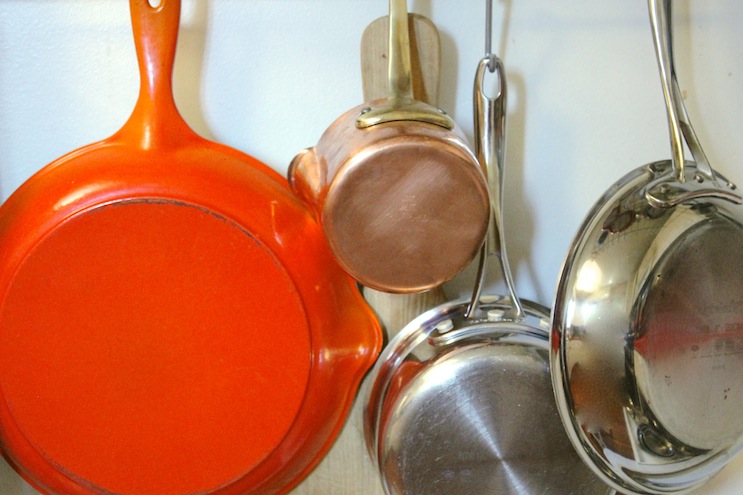
It can be daunting to shop for new cookware, there are just so. many. options. Luckily for you, we’ve rounded up 7 of the most useful questions to ask yourself when figuring out what type of cookware, and what brand, is best for you.
There comes a point in every young adult’s life when it’s finally time to ditch the cheap and well-worn cookware for something nicer. You’ve finally started using your kitchen to cook regularly instead of just using it as a place to house leftover pizza. You’ve begun to experiment with different recipes — maybe you’ve even found yourself enjoying cooking for other people or hosting dinner parties more and more. If all of this is true, then odds are you’ve also wondered if it’s time to invest in new pots and pans to make your life easier (and more aesthetically-pleasing, too). This can feel overwhelming.
If you’ve reached this point in your life, then odds are you’ve also deduced that good cookware isn’t cheap. In fact, it can be a pretty solid investment — one you want to last for many, many years to come. All this is to say, it’s important to do research when investing in new cookware for your kitchen, home, and life. If that feels like a large task to undertake, fear not, for there are really only a handful of questions to ask you when shopping for your new kitchen gear. Here are seven of the most important ones.
1. How much space do you have in your kitchen?
First, consider what kind of space you’re working with. Do you have tons of cabinet space, drawers, or shelves? Only one single cabinet? No counter space at all? Whatever your kitchen space is, assess that first. While it’s certainly tempting to buy all the things when you first get into upgrading your kitchen, if you don’t have room for an entire 16-piece cookware set and buy it anyway, you may end up with really nice pots and pans, but also a lot of clutter. And that’s never pleasant for anyone.
2. What are your most frequently cooked meals and how many people are you cooking for?
Are you a master of pancakes? Stews? Stir-fries? All of the above? Take a second to really, honestly think about what you cook each and every day. And, no, that one single time you made a chicken pot pie doesn’t count. Again, be honest about what you cook most often — and how many people you’re cooking for.
3. What is your biggest pain point re: your current cookware? Why are you looking for new cookware?
If you’re always scraping stuck-on food off of the bottom of your frying pans, it’s understandable why you might want new cookware. But maybe that’s the case for you. Buying new cookware might make sense for other reasons, too. Perhaps your pots and pans are too small for your current cooking habits. Maybe your family is growing and you need to make cooking large amounts as easy as possible. Hey, maybe you just want a prettier set of cookware to improve the overall look of your kitchen. Whatever the situation is, really assess why you’re looking to invest in new pieces. It’ll make choosing the right pieces that much easier.
4. How important is the cookware being easy to clean for you?
Think about your current process when it comes to doing dishes. Do you dread it? Do you have to soak pots and pants for stuck-on food for hours, or overnight? Do you not have a dishwasher at all and do all the heavy duty cleaning yourself?
As much as you might love cleaning, it’s possible you hate cleaning up the mess just as much. This means that considering cookware that is as easy and stress-free to clean as possible is probably a good idea. After all, less time cleaning means more time eating, and that’s pretty hard to argue with.
5. What is your budget?
We know, we know. You were probably hoping to avoid this question. It’s not such a fun one, but it is incredibly important. How much are you willing to invest in a quality cookware set for your home? A little? A lot? Either way, be honest about how much you’re able to spend and don’t overcommit to something you’re not prepared for. This is also where it’s worth thinking about a gradual process for investing in cookware.
Maybe instead of buying a full Set, you start with a single Fry Pan or Sauce Pan and then add on when you have more disposable income. Purchasing quality cookware doesn’t have to be an all-or-nothing experience. Luckily, many brands now offer payment plans to make buying cookware more accessible.
6. Do you like heavy or light pans?
This is all about personal preference, too. It’s also probably something you haven’t thought of yet. Some people prefer the feel of a heavier pan as the cook. Others want something lightweight and easy to move (this is especially good if you are going to be lifting it out of a cabinet that’s at a lower level). Assess how heavy your current pans are and then compare them against other options.
7. What color palette do you have in your home?
Finally, a fun question! What kind of color palette are you looking to have in your kitchen? Odds are you have invested in the look of your home and kitchen, so why not do the same for your cookware? And in case you didn’t know: Pots and pants don’t have to be boring.
Caraway offers shades of Perracotta, Cream, Sage, Navy, and Gray to make sure your cookware is as gorgeous as the rest of your home. An added benefit here? You can store them right on the counter instead of hiding them away. Pretty to look at, easy to reach, and entirely effective.
If you run a small-town restaurant you probably don’t have much competition. But you probably don’t have much of a customer base either. You can fix that by expanding your geographical reach. Create a specialty that will make your restaurant famous and bring customers from miles away. Offer to cater special events and consider hosting food competitions and you’ll put your little hamlet and your restaurant on the map.
Specialty Items
Perfect a menu item that will make people beg for more. Perhaps it’s Aunt Betty’s pecan pie, big juicy hamburgers with your secret sauce or fried chicken that makes your customers misty-eyed with memories of home. Feature local agricultural products on the menu.
Marketing
Capture the attention of passers-by with billboards and advertising posted at major highways and roads intersecting your town. Announce in bold letters that your restaurant is home of the famous cheesecake, or whatever your claim to fame might be. Place ads in regional newspapers with coupons to give tourists an incentive to drive out of their way for your restaurant. Suggest a weekly “Know your neighbor” column to the editor at the local newspaper and offer to give the first interview.
Food Festivals
Sponsor a festival featuring your specialty or the regional agriculture. If you live in the nation’s cranberry capital, create a killer cobbler recipe and feature it in the annual cranberry festival. Include your restaurant’s name in all promotional materials. Invite local and neighboring communities to attend and compete in a cooking contest. As word of the festival spreads it will attract visitors, boosting the economy of your small town and lending credibility to your restaurant. Look for opportunities to strut your cooking skills at other festivals and competitions.
Catering
Take your cooking skills on the road and offer to cater parties, festivals, sporting events and fundraisers. Catering is a great way for your restaurant to make an extra profit and will help you integrate into the community so you become an essential part of the fabric of your small town.
Specials
Design your menu around specific market segments. Hold a kids night so parents can feel comfortable about dining out with their small children without worrying about disturbing other diners. If your community has a large elderly population or many devout churchgoers, offer senior discounts or extended hours for “after church” Sunday brunch. Build up a regular trade with daily and weekly specials.
Cooking School
Share your culinary skills by offering cooking classes that focus on your strong suit, be it baking, grilling, soups or appetizers. Hold cooking demonstrations and let the audience sample the food. Invite a wine steward to present and serve wine pairings from the local winery that complement the food.
Customer Service
All the great food, ambiance and daily specials won’t keep customers and attract new ones if they don’t enjoy their dining experience. Offer excellent service with a smile and value for the money and your customers will keep coming back and help you grow your business through word of mouth.
Running a successful restaurant in a small town certainly presents unique challenges (and opportunities), particularly compared to your big-city counterparts, but take a look at these great marketing ideas to promote your distinct local food and service.
Like any business, large or small, brick-and-mortar or strictly online, marketing is still all about spreading the word about your product and services – whether it’s word of mouth, online or print promotions.
Much of what you’re doing to market your restaurant – beyond consistently serving quality food – is identifying and reaching potential customers in their space with an appealing and engaging message that will prompt them to come to your space. (Or to encourage current customers to keep coming!)
Try out any of these ideas to effectively market your small-town restaurant and increase business.
Get your restaurant listed on search engines
It’s a must-have marketing tool for any type of business – your listing in search engine business pages and mapping services. Fill out a Google My Business page to steer people to your door, people searching for a restaurant in your area or someone specifically searching for your restaurant. Your Google business profile also connects your would-be customers via Google Maps.
It’s free to set up a Google My Business listing – being listed correctly can make a difference in search engine traffic. And you can also use your Google profile to feature new menu items, promotions or updated hours.
“The best part about these searches is they’re already looking for what you offer – a great restaurant experience – so it doesn’t take much convincing to get them to choose you,” writes Adam Guild, a serial tech entrepreneur and CEO of restaurant marketing agency Placepull, in an article on Forbes’ Community Council website.
Share images of your delicious food
Social media is an excellent way to reach potential new customers and a photo is the surest way to entice them to come in. Whether it’s of your specialty dish or your everyday fare, share photos of your delicious food. Make it part of your marketing effort to post (edited) photos at prime times of day, when people are most likely hungry for what you’re serving – breakfast, lunch or dinner.
This quote from a modernresaurant.com article explains it best: “An image of a tasty dish is registered by the brain faster than any words, and it triggers all of the pleasure centers in the brain.”
Speaking of social media . . . if you don’t already have a profile page and accounts set up for your restaurant on key social media channels (Facebook, Instagram and Twitter), make it so. Ask your friends and family members help you build a following – by liking your page and, even further, encourage them to “check in” while they’re at your restaurant and ask them to share your posts with their friends and followers.
Get out in the community
Look for opportunities to get your restaurant name and menu out in the community. It can be tricky to get away to network (owning a restaurant business takes a lot of time!) but find venues that suit your schedule and spread the word in person – a Main Street event in your town or a Chamber of Commerce gathering in a nearby town.
Other ways to reach out to the community you’re in include running an ad in the local school program or creating and posting flyers with your menu (include a photo!) and your hours at well-traveled spots in town, such as the laundromat or a community or sports center.
Appreciate customers
As a small town restaurant owner, you might know many of your regular customers, especially if you’ve been in business for a while. Show them your appreciation by stopping at their table to say hello when you can – it goes a long way toward keeping them as repeat customers. Also, make it a point to visit a table of customers you’ve never seen before; they may be new to town or just passing through. Your simple gesture could give them another reason – besides the delicious food and great service – to tell the folks in their hometown about your restaurant.
Run coupons or special occasion specials
Make a coupon part of your ad in the town’s newspaper or school program or put it in a flyer and post it at the local library or any location where there’s a public bulletin board. The coupon can be as simple as a free drink with lunch or dinner. You can also create more incentives and “occasions” for customers to come to your restaurant by promoting a special menu items or price for a particular day or month.
It’s a popular technique used in city-located restaurants – create promotional opportunities around designated days of the month or use the entire month to celebrate someone or something. For example, Mother’s Day in May. There’s basically a day or month for every food or person – find what appeals to your customers, i.e., Siblings Day, National Military Spouse Day, or to your menu, such as National Pi Day. Research a designated day or month that best suits your restaurant specialty, whether it’s fried chicken or salsa.
Find the marketing ideas that help your restaurant build a loyal following, because when it comes to restaurant marketing repeat business is the key.
This article was originally posted in March, 2013, focusing on the only four ways to increase restaurant sales. A lot has changed in our industry since then as we saw the rise and fall of daily discounts, an ever-changing economy and a surge of new and focused restaurants in all segments.
As consumers are dining out more, there is a constant battle for their business and competition is no longer limited to restaurants “like me” — fast-casuals compete with both quick service and casual dining, and grocery and convenience stores are moving in on their share of wallet, too, not to mention other unconventional competitors like movie theaters and even gas stations. And fine dining is getting a face-lift to keep up with focused upscale casual restaurants.
As we look for ways to influence dining decisions across all occasions, one thing will not change: there are still only four ways to increase restaurant sales.
There are many marketing and advertising tactics you can use within each, and many ways a restaurant can look to increase profits, from controlling costs to smaller portions; but there really are only four ways for a restaurant to increase sales.
It’s no secret that restaurants need more customers to succeed, and attracting new customers is one of the ways in which you increase your customer count. There are a myriad of tactics to get new customers in the door. Some allow you to keep your brand equity, some may cause you to discount it, but getting new customers to try your location provides growth potential.
Tactics such as targeted emails, mobile applications, a social media presence and detailed web pages with directions and menus will draw new diners into your restaurant. Be sure you are working with a reputable company with valid email addresses that can help you reach the right targeted audience when it comes to acquiring new customers for your restaurant.
Once you gain those new customers, keep them coming back often. This can be accomplished by providing an engaging experience both inside the restaurant and after they leave. Exceptional service, food, value and atmosphere all contribute to the restaurant experience. But what about after they leave?
Individual communication with customers is key to staying top of mind and completing the customer experience. Responding to all customer feedback, acknowledging concerns, and thanking customers for compliments (typically through reviews) will let your customers know you care about their opinion and appreciate their choice to dine with you, which will set you apart from the nameless and faceless competition. Providing incentives for coming back or rewarding for a return visit reinforces the value you see in a returning customer.
Would you like to order an appetizer before your meal? I can recommend a great bottle of wine that would be perfect with both of your meals. Can I interest you in dessert? Seasoned fries with your burger?
Now that your seats are filled, ordering one extra item at each table can take your daily sales to a new level. Be sure your staff is attentive and reading the right signs to urge additional items. And when you pull in the right customers, they are willing to spend more, especially if it means they will get more restaurant rewards for doing so. For example, Rewards Network members actually spend an average of 23% more than non-members at program restaurant.
Now that your restaurant is filled and everyone has ordered dessert, there is only one more way to increase restaurant sales – do it all over again, as many times as possible in a day. This doesn’t mean you should rush customers through their experience, but it does mean that you should be staffed appropriately to handle your tables and traffic.
In a full service restaurant consider the following: Are checks being presented and collected in a timely manner? Are tables bussed and reset as soon as your guests leave? Do you have the right mix of tables for your average dinner party sizes?
Or, in the case of a limited service restaurant, do you have enough registers/POS systems in place? Can you add express ordering lines, or a separate station for call-ahead order pick-up?
Maximize your restaurant’s potential by mastering these four ways to increase restaurant sales.
Not sure how to start your food business? Find out what to consider, and how to make it happen with our practical 8-step guide.
Are you an aspiring restaurateur with a fresh new business idea, but not sure where to start? Well, it turns out that now might actually be a great time to take the plunge. Research shows that the food service industry is booming, and is set to reach $4.2 trillion with an annual CAGR of 3.6% by 2024.
But the idea of starting up your own F&B business may seem daunting, especially when the outlook for start-ups is bleak. Research shows that as many as 90% of new restaurants fail. The silver lining is that 10% don’t.
So to help you get started, we’ve pulled together an 8-step beginner’s guide, with insider tips to give you every chance at success.
1. Make a solid Business Plan
The first thing you’ll want to do before making any investment is do your research, diligently. Spend a few weeks (or even months) getting a deeper understanding of the broader foodservice landscape, your customer target, latest trends and competitors, and start writing a business plan for your investors. Think of it as exploring your 4C’s: customer, consumer, channel and context.
For this, you’ll want to:
Define your target market: Who is your new business targeting – baby boomers, gen X, gen Z, empty nesters, seniors? Once you’ve defined your target segment, make sure you understand what they buy, why they buy, where they buy from and what makes them tick. This will help you create a relevant, targeted offering.
Define your USP: Find what sets you apart from the rest of the herd. Have a look at what your direct (and indirect) competitors are doing, and establish your point of competitive difference. Now here, it doesn’t’ have to be radical, but it does have to be relevant. For example, if you’re targeting young families, creating a child-friendly establishment with nutritious children’s meals could be enough to give you a leg up on the competition.
Define your restaurant style: Are you thinking of opening a bakery, coffeeshop, quick-service, fast-casual or full-service dining restaurant? Each one of these channels requires their own unique approach, operating hours and investment, so make sure to pick one that suits you as an individual, and the work schedule that you’ll want to have.
Select your food type/menu offering: Think carefully about your menu and the type of food you’ll want to offer – and do so early on in the process. Find out what the latest menu trends are (especially for your target market) and tailor your offering to them. Some of the hottest trends right now include: vegetarian/vegan diets, allergy-friendly & gluten-free menu options and sourcing your produce locally.
Define your brand: Your branding – from your logo and the imagery you use, to the design of your menu, music you play and even and uniforms of your staff – define what your business is all about, and what you stand for. It sets the tone for your restaurant and lets your customers know what they can expect. Think carefully about how you want to position yourself and what you want your identity to be.
Once you have your business plan in place, go out into the world – and test it. Find some of your target customers and ask them for their thoughts and impressions. This could be as simple as polling a handful of people off the street to a full-blown market research study.
2. Secure your financing
Now it’s time to sort your finances. But not everyone who wants to start a restaurant has the personal funding to do so. In fact, most don’t.
Just remember that it’s likely to take years before you turn your first profit, and money will be tight at first. So think about starting small (you can always scale up) and choose your business partners wisely, because they’ll be around for a good while.
3. Choose your location
You know what they say: “location, location, location”. Well, as it turns out, that’s not always the case. The location you choose for your establishment will depend on the a number of factors, and unless you’re relying heavily on foot-traffic, you don’t necessarily need to be in the hottest new retail location.
Cost: based on your sales and profit projections, what can you afford to spend on rent?
Accessibility to potential customers: how are you customers getting to your restaurant, by foot, by car, by public transport?
Restrictive ordinances: some neighborhoods have strict noise regulations or restrictions on the times when your suppliers can deliver your produce
Proximity to other businesses: competitors and other businesses can influence your traffic, so map out what’s happening around you, and how it could affect your business
Plans for the future: consider what the neighborhood will look like in 2, 5, 10 years, and if there are any major development projects underway that could change the local landscape
4. Design the layout of your space
Once you have the a venue, it’s time to start working on the layout and design your space.
Of course, this will depend on the type of establishment you’re running, but typically restaurants dedicate about 45-60% of their space to the dining area, about 35% to the kitchen area and the remainder to storage and office space.
Think carefully about the layout of your kitchen and dining areas, and make sure there’s a smooth flow between the two. Prep space is also critical, so make sure your chefs have enough room to plate, garnish and decorate their dishes.
And most importantly: don’t cut corners in your dining area. This is the stage of the show – literally where all of the magic happens – so finding the right ambiance and decor to make your customers feel welcome is critical to success.
5. Choose your suppliers
As a restaurateur, you’ll be working with a number of different suppliers – from furnishings to POS systems, bar equipment, kitchen appliances and of course, food. Make your wish list, scope out your short and long-term budget, and go on the hunt for your partners. But remember that while you don’t want to cut corners when it comes to quality, over-priced suppliers can minimize your margins and run your business into the ground. So make sure to negotiate, hard.
But where do you start looking? Try going to wholesale retailers, local farmer’s markets, F&B conventions, ask for recommendations from fellow restaurateurs or just do a simple Google search.
You’ll be looking for a trustworthy supplier, who has a good track record of providing quality products and rota of successful partnerships. For food suppliers, be sure to about their delivery schedules and food safety management practices. And go local – they usually offer fresher ingredients.
6. Get your licences and permits
When it comes to regulations, every country, county and city is different. But make sure that you check in with your local regulatory office, and consider getting legal counsel to make sure you adhere to all of your local health & safety codes and food regulations. Just know that some licenses can take months to acquire, so make sure to get started on this process well before opening day.
7. Start hiring your employees
First, think about what staff you need to hire for your restaurant type. Based on the scale of your restaurant, this may include: HR managers, purchasing experts, accountants, marketing & sales managers, chefs and sommeliers, waiters, hosts, bartenders and cleaning and dish-washing staff. Make sure to hire enough staff for each job, and anticipate shift planning and back-ups in case of illnesses and vacations.
Look for candidates with sufficient experience and a successful track-record, who are quick on their feet, can multi-task and are efficient. All of your employees should work well under pressure, and customer-facing staff should have exceptional social skills.
And when it comes to hiring staff, you can never be too careful – so do your due diligence. Make sure to do background checks, conduct several face-to-face interviews and call their references.
8. Advertise your business
Before opening your restaurant, you’ll want to do a fair amount of advertising to alert your local community that there’s a new eatery on the block.
And while word of mouth is still the best form of publicity, here are a few other ways you might like to consider announcing your new venture:
Build a great website: make sure that it’s easy to navigate and includes all of the key information, including your opening times, menu, a booking engine and if/how you cater to special requests
Use social media: create accounts on Facebook, Twitter, LinkedIn and Instagram, and share relevant news and high-quality photos of your restaurant and the behind-the-scenes process as you’re getting ready for opening day
Put an ad in the local newspaper (and online news platform)
Host a soft opening: this is not only a great practice-run before opening day, but will also help create some buzz about your restaurant within your local community. Make the guest-list small, and consider having a soft opening for family & friends, followed by one for local businesses and partners.
Offer promotions to new guests: offer a free drink or dessert for the first 10, 50 or 100 customers – you’ll be remembered for your hospitality and generosity. After all, who doesn’t love free stuff?
And with that, we leave you with one last tip for success: work hard, don’t give up, and be prepared to risk it all. Starting any new venture will be a challenge and most likely an uphill battle, but in the end, nothing tastes sweeter than victory.
Maintaining your restaurant’s sales amidst fierce competition and rapidly changing trends can be a challenge. A key to success is finding the balance between acquiring new customers vs. retaining existing customers. With any new goal, you can best approach this by creating a plan and breaking it down into actionable steps. To help you reach the goal of increasing your restaurant sales, we’ve identified six restaurant improvement ideas you can try:
1. Diversify Your Services
Restaurant delivery and takeout services have been rising steadily in popularity and are essential to maintaining your sales in the current climate. Restrictions on restaurants due to the coronavirus pandemic are limiting dine-in services in many states. By diversifying your services to include takeout, delivery, and curbside pickup, you can help to increase your sales and weather this crisis. If you haven’t made plans to offer these services yet, here are some tips:
1. Create a takeout and delivery menu. Create a separate menu for takeout and delivery only and make it a simplified version of your dine-in menu. Choose items that are easy to prepare and travel well. Avoid delicate items that could fall apart or melt during transit.
2. Provide curbside pickup. For the quickest takeout service, you can provide curbside pickup to your customers. If you have a parking lot, reserve a couple of spaces near your entrance. Train your staff on the proper procedures for handling curbside orders and accepting payment.
3. Implement delivery services. If you’ve been thinking about setting up delivery services for your restaurant, now is the perfect time. You don’t even need your own delivery fleet thanks to the availability of reliable third party delivery services like Grub hub and Postmates. When your customers can’t come to you, you can adapt by bringing your services to their homes.
4. Optimize your drive-thru window. If you already have a drive-thru window, keep the area stocked with the items you need to serve customers quickly. Napkins, plastic cutlery, and condiments should be kept in plain sight so they are never forgotten. Test out your speakers to make sure they are working at the appropriate level and customers can hear you clearly. You can also work with your drive-thru team to set expectations about how long it should take orders to be completed.
5. Institute online ordering. Update your restaurant website to provide online ordering for takeout, delivery, and drive-thru service. Many customers find it easier to order online instead of by phone because they can place orders instantly at any time they choose. You can expedite the entire process by also accepting online payment.
2. Enhance Your Mobile Presence
It’s no secret that more and more people access the web primarily on their mobile devices. No matter how much time you put into your business’s website, if it’s not optimized for phones and tablets, the majority of your customers will bounce right off the page. Make sure you’re website looks great and functions properly on tablets, phones, and desktops alike. Try these tips to increase your mobile presence:
1. List your business on Google My Business. If you don’t have a website for your restaurant, the easiest thing you can do to help customers find your business is to create a Google My Business (GMB) listing with your address, hours of operation, phone number, and pictures of your location. GMB listings also allow your customers to review your restaurant and post photos of your food dishes online.
2. Create social media accounts. Similarly, try setting up social media accounts for your business and maintain an active online presence. If you don’t have time to monitor messages coming through your social networks, put one of your managers in charge of replying to inquiries.
3. Make announcements through social media. Another great thing about having a business account for social media is that you can make announcements for any events you may be hosting. You can use it to alert customers if your business is closed unexpectedly for a power outage or other unforeseen reason. Of course it’s also a perfect way to connect with your community and humanize your brand. Overall, you can use social media as a tool to accomplish many of the customer retention strategies mentioned above.
3. Attract New Customers to Your Restaurant
You probably know the importance of first impressions. A regular customer is more likely to forgive a sub-par experience than a brand new customer. But, even more common than a bad restaurant experience is a forgettable one. Making just a little extra effort to give your guests a great first experience goes a long way towards turning them into loyal customers. Take steps to stay in touch and create a personal connection with them.
Three Ways to Attract New Customers to Your Restaurant
You know that reaching new customers is important, but now the question is how to reach them. Below are a few common techniques you can use:
1. Participate in your city’s restaurant week. Restaurant week got its start in New York as a way to celebrate restaurants in the area. While every city has its own take on this tradition, the basic idea is that the city chooses one week out of the year to showcase their restaurants, and local restaurant owners can choose if they’d like to participate. Participating restaurants promote special discounted offers that are valid throughout the week. This is a great way to reach new customers because offering discounts encourages people to try your food.
If you want to learn more about how to get involved in this type of event, check out our blog on restaurant week.
2. Use marketing techniques to attract new customers. Of course, there are many traditional marketing tactics you can turn to, but ad placements can cost a lot of money. Having a strong social media presence, however, costs nothing but your time. If you want to put some money towards paid social media advertising, it can be an affordable alternative to purchasing ads in newspapers. You can even encourage customers to write reviews of their experience dining with you, which will add to your restaurant marketing efforts.
3. Develop a first-time customer program. This usually involves giving away coupons that encourage customers to come back. Alternatively, you can give your new customers a free appetizer, dessert, or beverage with the purchase of an entree. This is a great way of showing your customers how much you appreciate their business, and it can help set your business apart from the competition.
4. Use Customer Retention Strategies to Increase Customer Loyalty
In many cases, you can think of your loyal customers as free advertising. Word of mouth is one of the best ways any business will gain traction. People generally don’t trust paid ads, but they do trust their friend’s recommendation of a favorite place to eat. This means that your loyal customers are invaluable to the success of your business, and they should be treated as such.
Three Ways to Retain Customers
There are a few techniques many successful restaurants use to keep their best customers coming back time and time again:
1. Develop a customer loyalty program. There are a lot of ways you can set up your loyalty program, but one of the most common is to create a membership card that tracks each time a customer visits your restaurant, so they can work towards earning a free item of your choosing. Offering free drinks and desserts is often a good choice because they’re less expensive than an entree, but they will still make your guests feel appreciated. You can set up a card that tracks points in your POS system or a punch card that gets a new hole each time the customer visits.
2. Get involved in the local community. Hosting a charity event for a cause you care about is a great way to give back to the community and customers will notice the extra effort. For example, choose a day where you donate 10% of your profits to a charity. You can advertise the event in advance so that customers will know to dine in your restaurant that day if they’d like to contribute to the cause. Hosting cooking classes, beer tastings, or anything that educates customers about your product is another great way to help the local community feel invested in your brand.
3. Organize events. Something as simple as offering a space for community events, like company parties, can go a long way towards building a relationship with the community. Hosting weekly trivia encourages customers to come out to your bar on a weeknight. Booking live music is another great way to get customers to visit your business more regularly. Overall, organizing games or music helps people feel relaxed in your establishment and encourages them to stay longer and purchase more from your menu.
5. Train Your Servers on Upselling Techniques
A skilled server will be able to increase your restaurant’s sales with simple conversation. Effective upselling ultimately leaves the customer in control of their decision and doesn’t make them feel pressured to buy more. Rather, it will plant the seed that tempts them into ordering more than they may have originally intended. When it comes to teaching your staff these techniques, there are three main upselling tips to keep in mind:
1. Describe a menu item. The first opportunity to upsell comes shortly after guests are seated. Before drink orders are taken, encourage your servers to describe their favorite specialty drinks on the menu. Pointing out creative cocktails may entice a customer enough to try one, even if they had originally thought of having just water.
2. Assume your guests will want an entree. You can use the same technique as you did with the drinks. Servers can simply start describing items on the menu as a way to help customers think about trying one of those options. Another popular opportunity for upselling is to ask customers if they’d like to include an extra side with their meal. But if you charge extra for that side, be sure to mention it, so your guests aren’t confused when they get the bill.
3. Suggest more things to try. When everyone is finished with their entree, suggest that they try a dessert or after-dinner drinks. Again, naming off a few dessert options may tempt your customers to try one.
There’s even more opportunity to upsell if your server is speaking with a first-time customer because they will be eager to learn about your menu items. They’re also more likely to be interested in trying the server’s suggestions than a patron who has dined at your establishment many times.
6. Maximize Your Table Turnover Rate
The more food you sell, the more money you make, and the obvious way to sell more food is to serve more people. This is where table turnover comes into play. While you can’t control how long guests take to eat their meal, there are a few tricks that can increase the efficiency of your service. Here are a few things to try:
1. Have an organized seating system. Things like hostess stands and reservations are pretty common seating systems restaurants use to know how many guests to expect and manage the flow of guests coming through the door.
2. Keep your serving staff on schedule. Make sure that your restaurant has enough employees to cover all the guests in your dining room and train your staff take drink orders in a timely manner and bring out the check promptly at the end of the meal.
3. Use technology to your advantage. Some restaurants will use mobile POS systems to eliminate the need for servers to walk back and forth to the register to process credit cards.
4. Update your dining room. Some dining rooms are simply set up in such a way to make people want to linger. There are a few tricks your business can use when arranging your furniture that can encourage patrons to move along. Additionally, seating small parties at smaller tables can help ensure that you have ample space when larger parties arrive.
5. Make your menu more compact. Limiting the amount of items on your menu simplifies everything from the amount of time customers spend deciding on their meal to the amount of time your chef will take to prepare each dish.
If slow turnaround is an issue at your restaurant, try out a few different techniques to see if there’s a way you can improve the pace of your dining room.
Master the art of flipping tables with additional insight from our article on maximizing table turnover.
An important part of running any successful business is assessing and reassessing the way things are running. Restaurant owners are constantly thinking of ways to improve processes and increase efficiency. When it comes to finding ways of increasing sales in your restaurant, there are many factors to take into account. The good news is that many of the basic principles remain the same across all types of dining establishments, so if you follow the basic checklist of attracting new customers while thinking of ways to retain customers, and fill in those basic steps with practical business techniques and restaurant marketing, you’ll be on the road to success in no time.
Your restaurant menu is more than a list of items that you sell. It’s a guide for customers to decide what to buy. With a little elbow grease, you can improve your menu to convince customers to buy certain items, choose larger sizes, and taste test your latest specials. Managers need to know what they’re doing when they create a menu and why certain factors make customers spend more.
Before you redesign your menu, consider these five factors that could make or break your sales goals for the next quarter.
1. Promote the sale of specific items with photos.
Most people are visual learners and respond to visual stimulation. Seeing a picture of the appetizing meal they’re considering ordering can convince them to buy it.
In some studies, restaurants were able to boost sales by 30% by adding photos of food along with the text. Psychologists at Iowa State Universitya study with YMCA campers in a cafeteria. Kids who saw a photo of the salad they could order were 70% more likely to choose it than if the text was the only promo for the food item. The kids responded to the image in the same way they would respond to a plate of food in front of them.
Not only can you improve your restaurant menu by adding images to it, but you can also test promoting specific meals by including images of them instead of others. If you’re trying to sell a specific menu item, a high-quality image could entice customers to buy it more.
2. Improve your restaurant menu with descriptive titles.
There are certain words that customers respond to when they read a menu. Terms like fresh, organic, crispy, spicy, and savory all provide information about the food they’re about to order while eliciting an emotional response.
Consider the two descriptions below:
Salad with arugula, tomato, cucumber, and bacon.
Farmhouse salad with fresh arugula, tomato, cucumber, and crispy bacon.
Adding a few descriptive words makes the menu item seem more appealing and of higher quality.
Along with featuring adjectives on your digital signage, consider changing the names to better express your theme. Using the same example above, a farmhouse salad sounds more organic and rustic than simply calling it a salad. This title would work for a fast-casual Southern chain, regardless of whether a farmhouse actually had anything to do with the food.
A little creativity can help customers latch on to the memories associated with the food and convince them to buy your food based on their emotions, not just their stomachs and wallets.
3. Invest in digital signage boards.
One way you can constantly improve your restaurant menu is with digital signage. More fast-casual restaurants are moving toward this option in order to save money on printing fees and embrace the flexibility that comes with digital content.
A few reasons to consider making the switch to digital include:
Being able to constantly update content with better designs and layouts.
Easily and affordably test different layouts to see what works.
Remove out-of-stock products to prevent customer confusion and manage inventory.
You don’t have to keep breakfast, lunch, and dinner options up all day. You can change your menu content at different times of day using time-parting.
Your customers can clearly read and understand your menu.
Quickly change content to meet FDA Requirements for menus.
Even companies that have a relatively static menu without changing specials or different options throughout the day can benefit from digital signage.
Digital menu boards allow brands to constantly improve and create designs that grow their businesses.
4. Pay attention to how your customer’s eyes travel.
Along with making sure your menu content is clear and easy to read, there are a few tricks you can implement to convince customers to buy items with high-profit margins for your restaurant.
For example:
Customers tend to read a menu starting with the top right corner, making this a prime spot for dish placement.
Placing your most expensive dish in the first spot can boost sales, while making the rest of your dishes seem more affordable by comparison.
A third of diners consider ordering the first dish they see.
Starbucks is a great example of this menu placement. In the typical franchise, the customer’s eye starts in the top-right corner of the menu boards. This is where many locations post drink specials, lattes, and frappuccinos. After these more expensive items, the menu boards present drip coffee and tea, two of the less expensive categories.
Comparatively, a drip coffee seems less expensive than a latte, though many customers decide to order a seasonal item or frappuccino because they’re the first items they see.
5. Update your menus with seasonal items and specials.
Seasonal items and specials increase foot traffic and encourage customers to buy higher-ticketed items. When customers realize they only have a limited time to buy an item, they’re likely to make an effort to stop by and enjoy it while supplies last. The McDonald’s Shamrock Shake and McRib are two key examples of this.
Even monthly or weekly specials can encourage your regular customersto stray from their normal menu items and consider buying something new, more expensive, or seasonal.
The key to selling these items is placement. By featuring the special items prominently close to the top-right corner of your menu or creating a special call-out sign or poster for it, restaurant owners can ensure that their customers are informed about the new items and are eager to try them.
Upgrade Your Restaurant Menu Sooner Rather Than Later
The keys to improving your restaurant menu are testing and flexibility. Brands that try to improve their signage by following the latest, best practices are more likely to grow their sales than those who keep static signage for several months or years.
Is your store making the most of its menu boards? Spectrio can help! If you want to improve your sales through menu upgrades,schedule a demo with us on digital screens and menu displays.
Cookware is one of the most important things you’ll buy for your kitchen, but even professionals can get confused with the hundreds of choices of materials and types of pans out there. Restaurant owners think carefully about the equipment they purchase, and pots and pans are no exception.
While there are a lot of options for home chefs, knowing the pros and cons of the most popular choices and which type of cooking they are best for, is important in deciding what to buy for your kitchen.
Cast Iron
Cast iron is a popular type of cookware for many chefs, both professional and amateur. It’s got a lot of benefits, but there are a few things you need to consider.
Pros:
Cast iron is prized for a number of reasons, starting with the fact that it’s got a natural, nonstick surface if you take care of it properly. It’s also extremely durable and will last a lifetime. In fact, many people who own cast iron skillets will tell you that they’ve been in the family for generations; it really does last forever.
Perhaps the biggest reason to use cast iron is that it heats evenly, and will brown meat and fish like virtually nothing else. You end up with a perfectly golden browned crust on your food, and it doesn’t stick. It’s ideal for cooking meat, vegetables, eggs, burgers, and more.
Cons:
With all the pros of using cast iron, it doesn’t come without a few negatives. For starters, the durability of cast iron makes it extremely heavy. This can make it difficult for some people to use. Draining a cast iron pot can be quite the task, even for the strongest chefs.
It also requires special care. Although not difficult to care for, it does require maintenance to keep it working properly. Cast iron must be “seasoned” on a regular basis, or coated with a thin layer of oil and heated for an hour or so. This is what makes it such a slick non-stick surface. You can’t put cast iron in the dishwasher, and you should avoid using soap or abrasive cleaners on it. Properly taken care of, cast iron will rarely need anything more than to be wiped down with a paper towel.
One more word of caution about cast iron: Raw cast iron (a typical black skillet) shouldn’t be used to cook acidic foods. Citrus juices, tomatoes, or vinegar can break down the seasoning of your pan, which can take time to build up again.
Bottom line: If you’re willing to learn to care for it, and don’t mind the weight, cast iron can be an amazing tool for cooking flavorful foods.
Stainless Steel
Stainless steel is one of the most popular types of cookware, and for good reason, not all stainless steel pans are created equal. Let’s go over the pros and cons of this cookware.
Pros:
Stainless steel retains heat fairly well, but not as well as some other materials. For this reason, most stainless steel cookware has a copper core, which helps it heat food evenly. Good stainless steel cookware is heavy and durable and can last years if taken care of properly. It’s also budget-friendly; you can buy everything from a cheap set at your local discount retailer to expensive high-end cookware in your favorite gourmet kitchen shop.
It’s easy to clean, and in most cases can be put in the dishwasher, although you should check with the manufacturer of the specific pieces you own. It can go from stove to oven as long as it’s all stainless steel (pieces with plastic or rubber handles may not be oven safe.)
Cons:
If you’re looking for a versatile set of cookware that will be useful in most types of cooking, stainless steel is the way to go. The only real cons come from the type that you use.
If you buy cheap pots and pans made of lightweight material, you will likely have trouble retaining heat, and the metal may warp or pit over time. Handles made of plastic mean you can’t put your pan in the oven if necessary, which can be a pain if you do a lot of stove to oven cooking.
Bottom line: You don’t need to buy the most expensive set of stainless steel pots and pans on the market unless you are an experienced chef looking to get the most out of your cookware. The cheapest products won’t do you any good, and will likely need to be replaced. There are plenty of high-quality mid-priced sets that will serve the average cook well.
Copper
Copper is one of the best conductors of heat available, but it’s not as widely used today as it once was. This is mostly due to the availability and durability of other materials.
Pros:
In addition to being strikingly beautiful, copper cookware offers some of the best heat retentions you’ll find in pots and pans. This means even cooking for all types of foods.
That’s about it for the pros of copper, and unfortunately, there are quite a few cons.
Cons:
It was expensive. Unlike stainless steel, which is readily available at all price points, you’ll only likely find copper in high-end cookware stores, and you’ll pay several hundred dollars for a single small pot or pan.
It’s also reactive, which like cast iron, means that you can’t cook everything in it. Acidic foods may have a metallic taste, and the compounds in the copper may even discolor some foods. It’s not necessarily dangerous, but it’s visually unappealing.
Copper also requires regular maintenance and polishing with the copper cleaner to maintain that beautiful look. You definitely don’t want to put it in the dishwasher, and depending on what you cook in it, cleaning can be a drag.
Bottom line: Unless you are a professional with the knowledge and desire to care for copper pots (and the money to invest in a set), stick to stainless steel with a copper core. While not as pretty, it’s a much better option for the average cook.
Non-Stick
If you’re new to cooking, you may think that non-stick cookware is the way to go; after all, why would you want your food to stick if it doesn’t have to? Unfortunately, there’s more to this popular cookware than meets the eye.
Pros:
If you cook a lot of foods that tend to stick like eggs or fish, non-stick cookware can be your friend, especially if you are inexperienced in the kitchen. Most non-stick cookware is easy to handle, and fairly inexpensive, which makes it a good choice for new cooks that don’t know exactly what they want.
Cons:
The cons of non-stick cookware should not be taken lightly. For starters, the Teflon coating that is used to keep foods from sticking to these pans has been shown to be toxic. They’re still deemed safe to use by the FDA, but the more you use these pans, the more of this toxic material you are ingesting. If you use metal utensils or regularly heat your pans to high temperatures, you’re ingesting even more of these fumes or materials.
Another reason not to use them is that they simply aren’t the best when it comes to actual cooking. Most won’t heat evenly, and if you like a browned crust on your fish or meat, you will have a difficult time achieving that in a non-stick skillet.
And, finally, non-stick pans don’t last long if used regularly, no matter how careful you are when using them, which means you’re looking to replace them fairly often.
Bottom line: Even if you eat a lot of foods that tend to stick, non-stick cookware isn’t the best option. A better choice would be to learn cooking techniques that make using other types of cookware easy to use. Cast iron is a much better non-stick option.
Conclusion
Choosing cookware can be overwhelming, but it doesn’t have to be. Whether you are new to cooking or have been cooking for years, the right cookware can definitely make the job easier. Before shopping, figure out your budget, as well as what types of foods you’ll be cooking. You’ll likely find that a decent set of stainless steel pots and pans, with maybe a cast iron skillet or two, will be more than enough to meet your needs.
If you are considering starting a business, it’s important to put careful consideration into the type of business structure you will have. The type of business you select can impact how much you pay in taxes, the paperwork you must file, your personal liability and even your ability to raise money. Choosing the right type of business takes research and careful assessment. In this article, we will discuss the different types of businesses and offer tips on how you can choose which type to start.
Types of businesses
Here are the most common types of business structures, although it’s important to note that liability, ownership rules, taxes and filing requirements can vary by state.
Sole proprietorship
This is typically the simplest type of business, with only a single person or a married couple responsible for all the company’s profits and debts. If you intend to work alone, this may be the best option for you. This type of business can be especially appealing because income and expenses are included on your personal income tax record. Your profits and losses are recorded on the Schedule C tax form and the amount is transferred to your personal tax return. Losses you suffer in the business can offset income earned from other sources. With this type of business, you also have complete ownership and make all the decisions.
The disadvantage of a sole proprietorship is that you are liable, personally, for your company’s liabilities. This means that your personal assets could be placed at risk to satisfy a business debt or settle a legal claim filed against you.
Partnership
A partnership can be an ideal choice if your business is going to be owned and operated by multiple people. This type of business comes in two forms: general partnership and limited partnerships. With a general partnership, the partners assume responsibility for the debts. With a limited partnership, though, there are both general and limited partners. The limited partners are investors only and have no control over the company and are not subject to liabilities. The general partners own and operate the business and assume the liabilities.
Unless you intend to have multiple passive investors, the limited partnership may not best the best type of business to start as a new business owner because of the administrative complexities and required filings. If you expect to have two or more partners who are actively involved in the business, a general partnership is easier. One of the advantages of this type of business is the tax benefits. A partnership doesn’t pay tax on its income but instead passes the profits and losses on to the partners. They are typically more expensive to start because more extensive accounting and legal services are required.
Limited liability company (LLC)
This type of company allows owners, partners and shareholders to limit their personal liability to protect their personal assets. An LLC is not incorporated but it enjoys the limited liability of a corporation. The LLC can be taxed as a sole proprietorship, partnership or corporation.
Some of the benefits of an LLC include no limitations on the number of shareholders the business can have. Also, any owner or member can have a full participatory role in the operation of the business. There is also flexibility with the distribution of profits. Profits and losses don’t have to be distributed in proportion to the money that the investor puts in. The disadvantage of this type of business is that because LLCs are a relatively new business structure, the tax treatment can vary by state.
Corporation – C corp
Corporations offer the strongest amount of personal liability protection, but the cost to form a corporation is also higher. Corporations also require more extensive reporting, record-keeping and operational processes. Corporations are completely independent of shareholders. They pay income tax on profits and in some cases can be taxed twice. They do have an advantage when raising capital because they can raise money by selling stock. Stock options can be useful in attracting employees.
Corporation – S corp
An S corporation has the liability protection of corporations along with several tax benefits. The owners of S corporations can use the cash method of accounting if they don’t have inventory. They can have up to 75 shareholders, which makes it possible to attract more capital. S corporations must file articles of incorporation like all corporations and hold directors and shareholder meetings. They also must allow shareholders to vote on major decisions. S corporations can only issue common stock, which could impact the corporation’s ability to raise capital.
Corporation – B corp
A B corporation, also called a benefit corporation, is a for-profit corporation that is driven by mission and profit. They are taxed in the same way as C corporations but are focused more on purpose, accountability and transparency.
Corporation – nonprofit
Nonprofit corporations are organized with the intent of doing philanthropic work. Because their work benefits the public, they can receive tax-exempt status and not pay taxes on profits. They follow organizational rules that are like a C corp but also have special rules regarding profits.
How to choose which type to start
Here are the main factors you will need to consider before choosing the type of legal structure for your business.
Flexibility
Your goal when selecting a type of business is to identify the one that allows for maximum flexibility with the ownership structure. You need to consider the goals, concerns, needs and financial situations of each owner.
Liability
Another factor you need to consider when forming your business is the extent to which you need to be protected from liability. You need to examine the potential liability of your organization and decide if you can personally afford the risk. If you cannot, a partnership or sole proprietorship is likely not the best type of business to start.
Complexity
You will need to establish the level of complexity you want to take on with your business. Sole proprietorships are the simplest option and incorporating your business can become highly complex, with state and federal reporting requirements.
Taxes
You will also need to consider the tax implications for the organization and what the opportunities are for minimizing taxation. There are more tax options for corporations than partnerships or sole proprietorships. Double taxation can be a problem with corporations but can be avoided with an S corp.
Control
You need to determine the amount of control you want over the business. If you need to have complete control, an LLC or sole proprietorship may be the best choice. While a single person can control a corporation, as the business grows, it will become a board-directed entity.
Capital investment
If you plan to seek outside funding for your business, you may want to establish a corporation. Corporations can secure additional funding and sell stock as opposed to sole proprietorships, which can only obtain funding through their personal bank accounts or by taking on partners.
Humans have an inherent need to build relationships, and when these relationships are healthy it can lead to better mental health and emotional wellbeing. A positive relationship can be shared between any two people that support, love, and encourage each other. Annually, we recognize National Friendship Day on the first Sunday of August to celebrate the positive relationships in our lives. At Acenda, we are celebrating this day by sharing the four benefits of having uplifting and healthy relationships.
1. Healthy relationships encourage personal growth.
There’s no better feeling than having someone cheer you on during life’s ups and downs. When you have someone in your life who will support you no matter what, you are more confident and self-assured. These relationships will enable you to take greater risks and chase after your dreams because you have a strong foundation of support no matter the outcome.
2. Positive relationships add meaning to our life.
It’s human nature to want to feel needed and to be a part of something that is bigger than ourselves. Many people strive to make a positive change in this world and enjoy the feeling of doing something good for someone else. Being in a loving and healthy relationship, romantic or platonic, can give a person a sense of purpose and fulfillment. In fact, supporting others will in turn make you happier and stronger!
3. Healthy relationships can decrease stress and lead to a longer life.
Research suggests that the social and emotional support from a committed relationship or strong friendship can be a buffer against stress. Studies also suggest many biological benefits, including lower blood pressure and stronger immune systems. Reversely, studies have also suggested that a lack of social relationships can have the same effect as smoking 15 cigarettes a day.
4. Social support in life.
It’s helpful to surround yourself with people that you trust and can learn from. This could mean being an excellent listener, a wise mentor, or being available to a helpful friend in any situation, like moving houses. No matter how big or small, these are all supportive ways to strengthen your social support system.
Above all, everyone deserves to have healthy relationships that provide joy and promote personal growth. Agenda is here to help if you or someone you know is experiencing challenges in their lives that are causing increased isolation and loneliness. Our clinicians are trained to help adults and youth overcome social anxiety, depression, and trauma so that they can thrive in the modern world.